The Digital Grapevine: Why Context Is Becoming the Real AI Advantage
AI has changed the cost of production.
That is the starting point.
Content is easier to generate. Emails are easier to draft. Campaigns are easier to personalize. Code is easier to scaffold. Research is easier to summarize. Work that once required teams, tools, and time can now be compressed into a prompt, a workflow, or an agent.
But lower production cost does not remove the need for judgment.
It moves the bottleneck.
The problem is no longer whether a business can create more. It is whether the business can create the right thing, for the right person, in the right situation, with enough context to be useful.
That is the argument running through Robert Lavigne’s ten-part Medium series, The Digital Grapevine.
The series is not really about content.
It is about systems.
More specifically, it is about what happens when AI makes output abundant and exposes context as the scarce layer underneath.
The Digital Grapevine audit also frames the broader brand as an AI-oriented consultancy centered on Robert Lavigne, with visible positioning around AI integration, LLM applications, digital strategy, and practical technology guidance. That matters because these ten essays are not isolated posts. They operate as a compact strategy layer for the larger Digital Grapevine thesis.
The ten articles
The full Medium list is here:
The Digital Grapevine Medium List
The ten articles are:
- Why Relevance Is Becoming More Valuable Than Reach [001]
- The Businesses That Win in AI Will Be the Ones That Understand Context Best [002]
- Content Abundance Is Creating a Context Shortage [003]
- Why Generic AI Output Fails in Specific Environments [004]
- Context Is the New Distribution Advantage [005]
- From Search to Situational Intelligence [006]
- Why Personalization Without Context Still Feels Generic [007]
- In an AI World, Fit Matters More Than Volume [008]
- Context Is What Makes AI Feel Intelligent [009]
- Why Most AI Content Strategies Still Belong to the Old Internet [010]
The shift
The old internet rewarded reach.
The new AI layer rewards fit.
That does not mean reach is irrelevant. Distribution still matters. Attention still matters. Search still matters. Audience still matters.
But they matter differently now.
When production was expensive, the ability to publish consistently created an advantage. When distribution was hard, access to channels created leverage. When content creation required human time, volume could signal seriousness.
AI weakens that logic.
If everyone can produce more, then more is no longer enough.
The bottleneck moves from production to selection.
From reach to relevance.
From output to context.
A company can send more emails and create less trust. It can publish more pages and create less clarity. It can automate more interactions and make the customer experience feel less intelligent.
Volume is not the same as leverage.
Relevance is replacing reach
The first article, Why Relevance Is Becoming More Valuable Than Reach, sets the frame.
Reach was a rational strategy when attention was harder to access and content was harder to produce. The more people you reached, the more chances you had to create demand.
That logic still works in some environments.
But AI changes the economics.
If every company can generate more campaigns, more posts, more landing pages, and more variants, the reader’s problem becomes filtering. The buyer’s problem becomes trust. The operator’s problem becomes knowing what actually matters.
The scarce thing is no longer another message.
It is a useful message.
That is the first important move in the series. Relevance is not treated as a copywriting preference. It is treated as a systems problem.
A relevant system knows more than the recipient’s name, title, and company.
It understands timing. It understands state. It understands previous actions. It understands intent. It understands what has already happened and what should probably happen next.
That is not just personalization.
That is context.
Context is the moat
The second article, The Businesses That Win in AI Will Be the Ones That Understand Context Best, makes the thesis explicit.
Model access is becoming less defensible.
Many teams can use the same foundation models. Many teams can build with the same APIs. Many teams can buy the same tools. Over time, raw access to AI becomes less of an edge.
The edge moves to what surrounds the model.
What does the system know?
What history can it retrieve?
What constraints does it respect?
What business logic shapes the output?
What does it know about the user’s current state?
What does it know not to do?
The model matters. But the model is not the whole system.
Context is the layer that turns general capability into specific usefulness.
That distinction is central.
A generic AI system can produce fluent output. A context-aware system can produce usable output.
The difference is operational.
Abundance creates a new shortage
The third article, Content Abundance Is Creating a Context Shortage, names the tradeoff clearly.
AI solves one shortage and creates another.
It solves the shortage of drafts, summaries, outlines, emails, scripts, and pages.
It creates a shortage of coherence.
More content means more decisions. More variants mean more review. More automation means more risk of misalignment. More generated material means more need for routing, governance, and quality control.
The question changes.
It is no longer, “Can we produce enough?”
It becomes, “Can we tell what belongs?”
That is the context shortage.
A support team does not need a polite answer in isolation. It needs an answer shaped by ticket history, account tier, escalation status, previous failures, and the customer’s current frustration.
A sales team does not need another outreach sequence. It needs to know whether the buyer is early, active, blocked, skeptical, or ready.
A content team does not need twenty more articles. It needs the few pieces that clarify the market, reduce friction, and support a real decision.
Production is cheap.
Coherence is not.
Generic output fails in specific environments
The fourth article, Why Generic AI Output Fails in Specific Environments, moves from market logic into implementation.
This is where many AI projects break.
The demo works.
The production workflow does not.
The reason is usually context.
Real environments contain local rules. They contain exceptions. They contain history. They contain compliance constraints, customer preferences, internal politics, legacy systems, and decisions made three quarters ago that still matter.
A generic model does not automatically know these things.
It may produce something that looks right.
That is not enough.
A legal draft can be well written and still violate internal risk tolerance. A customer reply can be polite and still ignore the real escalation. A product recommendation can be plausible and still fail because it does not reflect the user’s constraints.
The output arrives quickly.
Confidence does not.
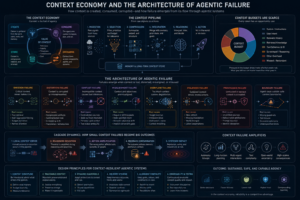
The work shifts to system design: retrieval, memory, policy, workflow state, validation, and escalation.
This is where AI stops being a tool problem and becomes an architecture problem.
Distribution becomes state-aware
The fifth article, Context Is the New Distribution Advantage, reframes distribution.
The old distribution question was: where can we reach people?
The new distribution question is: what does this situation require?
That is a different operating model.
A calendar-based onboarding sequence may send the same message to every user on day three. A context-aware system asks what the user has actually done. Did they complete setup? Did they invite a teammate? Did they fail at the same step twice? Did they stop after importing data? Did they read documentation but not activate?
The message should depend on the state.
Sometimes the right response is an email.
Sometimes it is an in-product nudge.
Sometimes it is a human intervention.
Sometimes it is no message at all.
Distribution becomes less about broadcasting and more about timing.
The advantage is not just having the channel.
The advantage is knowing when the channel should be used.
Search is not enough
The sixth article, From Search to Situational Intelligence, is the most systems-oriented piece in the series.
Search waits for a question.
Situational intelligence notices that something matters.
That is the shift.
Search assumes the user knows what to ask. It assumes the user can recognize the problem, formulate the query, evaluate the answer, and decide what to do next.
That works for many tasks.
It fails in environments where the most important signal is the one nobody has asked about yet.
Consider an operations team investigating a production issue.
A search-based AI assistant can answer questions about logs, deploys, incidents, and service history. That is useful. But if the system has enough context, it should also be able to surface the pattern before the human asks the perfect question.
The issue is not access to information.
The issue is awareness of the situation.
This is a higher bar. It requires state models, thresholds, signal interpretation, and escalation rules. It also requires restraint. A system that surfaces everything is just another noise source.
Situational intelligence is not more alerts.
It is better judgment about what deserves attention.
Personalization is not context
The seventh article, Why Personalization Without Context Still Feels Generic, makes a useful distinction.
Most personalization is shallow.
It inserts a name. It references a company. It mentions an industry. It changes a headline based on a segment.
That can help.
But it does not create understanding.
A message can be personalized and still feel generic because it knows facts about the person without understanding the person’s situation.
Context goes deeper.
It asks what changed. What the user is trying to solve. What signals are visible. What happened recently. What pressure exists now. What the person already knows. What would actually help.
This distinction matters because AI makes shallow personalization easy.
It can generate tailored intros at scale. It can vary copy by persona. It can scrape surface signals and produce messages that look specific.
But looking specific is not the same as being useful.
Accurate addressing is not situational relevance.
That line matters.
Fit beats volume
The eighth article, In an AI World, Fit Matters More Than Volume, shifts the discussion to measurement.
This is where many organizations will get AI wrong.
They will measure what AI makes easy.
More posts. More campaigns. More pages. More variants. More outbound. More documentation. More code.
Those numbers are visible. They are easy to report. They create the feeling of progress.
But they may not measure leverage.
If AI increases output while reducing trust, the system is worse.
If AI increases content while lowering conversion quality, the system is worse.
If AI increases automation while increasing review burden, the system is worse.
If AI increases speed while increasing rework, the system is worse.
The metric cannot only be volume.
The metric has to include fit.
Does the output match the situation?
Does it reduce uncertainty?
Does it help the user move forward?
Does it respect constraints?
Does it improve the decision?
Does it create confidence?
Fit is harder to measure than throughput.
That is why it matters.
Intelligence feels like context
The ninth article, Context Is What Makes AI Feel Intelligent, explains why some AI systems feel useful and others feel mechanical.
Raw fluency is no longer impressive for long.
Users adapt quickly. Once they expect fluent text, fluency stops feeling intelligent. What feels intelligent is continuity.
The system remembers the goal.
It understands the constraint.
It knows what happened earlier.
It adapts to the user’s level.
It avoids repeating irrelevant advice.
It brings forward the right information at the right time.
That is what creates the feeling of intelligence.
Not because the model is magically aware.
Because the system has context.
A generic assistant can answer a question.
A context-aware assistant can help with the work.
That difference is the product.
AI can scale the wrong strategy
The final article, Why Most AI Content Strategies Still Belong to the Old Internet, closes the loop.
This is the warning.
Many AI content strategies are old internet strategies with faster production.
They still assume that more content means more opportunity. They still treat volume as proof of seriousness. They still optimize around publishing cadence, search coverage, channel presence, and output velocity.
AI makes that easier.
It does not make it right.
If the strategy is generic, AI makes it more efficiently generic.
If the strategy is misaligned, AI accelerates the misalignment.
If the strategy is volume-first, AI multiplies the noise.
AI does not fix a broken strategy.
It scales it.
That is the strongest conclusion in the series.
What the series is really saying
The ten articles can be read as a sequence of shifts:
Reach → relevance
Volume → fit
Personalization → context
Search → situational intelligence
Prompting → system design
Generation → orchestration
Output → trust
The pattern is consistent.
AI removes friction from production. That creates a new scarcity around judgment, context, validation, and control.
This does not eliminate human work.
It changes where human work matters.
The valuable work moves upstream and downstream of generation.
Upstream: defining the problem, constraints, context, data sources, user state, and success criteria.
Downstream: reviewing, validating, routing, measuring, correcting, and deciding what should happen next.
The generated artifact is only the middle.
The leverage is around it.
A concrete example
Take a simple customer onboarding flow.
The old version sends a five-email sequence over ten days.
Day one: welcome.
Day three: setup tips.
Day five: feature overview.
Day seven: case study.
Day ten: upgrade prompt.
This is not wrong. It is just limited.
It uses time as a proxy for state.
A context-aware version works differently.
It knows whether the user completed setup. It knows whether they invited teammates. It knows whether they connected data. It knows whether they failed at the same step twice. It knows whether they opened help docs. It knows whether similar users usually churn after this pattern.
Now the system can act differently.
A user who completed setup does not need setup tips.
A user who failed configuration twice may need guided support.
A user who invited five teammates may need admin documentation.
A user who imported data but never created a report may need a workflow template.
A user who is inactive after reading pricing may need a different intervention.
Same product.
Different system.
The advantage is not more messages.
The advantage is better state awareness.