Synthesizing Historical Computation, Search Engine Optimization, and Agentic Artificial Intelligence
Introduction: The Paradigm Shift Toward Context-Aware Systems
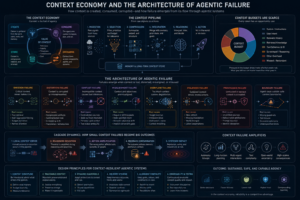
The contemporary digital landscape is undergoing a profound structural metamorphosis, transitioning violently from the rapid, frictionless generation of raw data to the complex orchestration of highly contextual, resilient synthetic intelligence. This continuous evolution signifies a definitive departure from traditional, volume-centric models of digital interaction, moving toward an era characterized by the “context economy”. In this emerging economic and technological paradigm, the mere production of content through Generative Artificial Intelligence (AI) is increasingly viewed as an abundant, low-friction, and ultimately devalued commodity. As algorithms become capable of generating infinite variations of text and media instantaneously, true systemic value is no longer found in the generation of artifacts, but rather, it is derived from algorithmic coherence, outcome-focused design, and the rigorous governance of machine outputs.
This transition demands a fundamental, structural reevaluation of how artificial intelligence is integrated into real-world applications and enterprise environments. Rather than treating generative models as standalone, omnipotent solutions, modern digital strategy requires building a robust, deterministic architecture around inherently probabilistic AI systems. This infrastructure must encompass advanced memory retention protocols, precise logical framing mechanisms, seamless cross-platform orchestration, and strict narrative continuity to ensure that synthetic intelligence remains highly actionable and contextually appropriate within professional workflows. By prioritizing practical, governed AI integration, organizations can transcend the purely theoretical or experimental phase of artificial intelligence, transforming abstract technological concepts into tangible digital experiences and governable enterprise ecosystems.
The digital revolution, however, is not a localized contemporary event initiated by the sudden advent of large language models. It represents a pervasive paradigm shift in human history, characterized by the systematic democratization of computational power across millennia. By tracing this trajectory from localized institutional mainframes to ubiquitous consumer platforms, one can understand the mechanisms that have fundamentally reorganized global communication, macroeconomics, and the socio-economic fabric of modern civilization. This exhaustive analysis explores the deep historical trajectory of computational logic, the socio-economic implications of infrastructural decentralization, and the modern systemic risks associated with the deployment of agentic artificial intelligence. Through the synthesis of historical precedents, contemporary search engine optimization strategies, and robust digital identity management protocols, this report elucidates the defensive and offensive mechanisms required to navigate the imminent complexities of the context economy.
Deep Historical Antecedents: Abstraction and Programmable Logic
To fully comprehend the current state of algorithmic complexity and the architectural demands of the context economy, it is intellectually necessary to trace the historical democratization of computational power back to its earliest mechanical origins. The conceptual foundations of modern digital ecosystems can be definitively traced back to the invention and widespread utilization of the Abacus, which emerged in human civilization circa 1100 BCE.
The Abacus represented a profound cognitive breakthrough for early societies. Prior to its invention, mathematics and numerical representation were largely theoretical or dependent on rudimentary physical counting systems that could not easily scale. The Abacus demonstrated empirically that highly complex mathematical calculations could be accurately represented and manipulated through physical abstraction. More importantly for the trajectory of computer science, its structural reliance on discrete bead positions—wherein a bead is either engaged in a specific mathematical state or disengaged from it—served as the earliest physical anticipation of binary digital logic. This binary state, representing unambiguous “on” or “off” conditions, entirely underpins the foundational architecture of all modern microprocessors and logical gates utilized in contemporary computing. The physical mechanism of the Abacus proved that complex human intent could be encoded into a systematic, mechanical state, a concept that would remain dormant until the industrial revolution.
This historical trajectory advanced significantly with the invention of the Jacquard Loom between the years 1804 and 1805 by the visionary inventor Joseph-Marie Jacquard. Operating within the context of the rapidly industrializing textile industry, this automated machine utilized interchangeable punched cards to dictate intricate, highly variable weaving patterns without requiring the manual intervention of a human weaver for each structural change.
The Jacquard Loom represents a highly critical inflection point in the overarching history of technology: it functioned as the first tangible, operational instance of programmable logic, serving essentially as an early form of read-only software. By separating the operational hardware of the physical loom from the instructional data encoded onto the external punched cards, the Jacquard Loom provided early empirical proof that machines could execute highly variable, infinitely repeatable complex instructions based purely on external data inputs, rather than relying on fixed physical wiring or manual human manipulation. This ideological separation of hardware execution from software instruction laid the direct philosophical groundwork for modern operating systems, where interchangeable software applications direct the physical execution of generalized computational hardware.
The Dawn of Electronic Computation and Solid-State Miniaturization
The transition from physical and mechanical abstraction to purely electronic computation occurred in the mid-twentieth century, radically accelerating the global capacity for data processing at scale. Conceptualized and developed between 1937 and 1939 by innovators John Atanasoff and Clifford Berry, the Atanasoff-Berry Computer (ABC) emerged as the world’s first electronic digital computer.
The architectural design of the ABC decisively abandoned traditional, human-centric decimal systems in favor of strict binary arithmetic, aligning machine calculation with the fundamental electrical realities of open and closed circuits. Furthermore, the system utilized capacitors for the purpose of temporary data storage. This capacitive storage mechanism functioned as a direct, functional precursor to modern Dynamic Random-Access Memory (DRAM), establishing the foundation for volatile electronic memory retention that allows computers to store the immediate states of complex calculations.
Subsequent mid-century advancements focused heavily on improving the flexibility, speed, and agility of machine execution. In 1949, the Manchester Mark I was successfully developed, distinguishing itself as one of the earliest operational stored-program digital computers. The architectural philosophy of the Manchester Mark I was revolutionary; by storing executable instructions within the exact same electronic memory infrastructure as the operational data, the machine achieved unprecedented operational agility. This specific innovation allowed the machine to seamlessly switch between completely disparate computational tasks without the prohibitive necessity for manual, physical rewiring by teams of human operators. The stored-program concept finalized the transition from machines as single-purpose calculators to machines as universal information processors.
However, the true global democratization of computational power—a prerequisite for the modern digital revolution—required a radical departure from the massive, highly fragile, and incredibly heat-intensive vacuum tubes that characterized the architecture of early institutional mainframes. In 1947, dedicated researchers operating at Bell Laboratories—specifically the team of John Bardeen, Walter Brattain, and William Shockley—invented the transistor.
By utilizing advanced semiconductor materials to govern and control electrical currents, the transistor facilitated exponential hardware miniaturization. This solid-state innovation effectively replaced the vacuum tube, providing the necessary physical infrastructure and thermal efficiency for the subsequent development of highly complex integrated circuits and, eventually, modern microprocessors. The invention of the transistor effectively untethered computational power from localized, heavily climate-controlled institutional facilities, setting the physical stage for personal computing devices to enter commercial and consumer markets.
Infrastructural Routing and the Genesis of Network Syntax
The mid-to-late twentieth century witnessed a shift from isolated, albeit powerful, computational mainframes to interconnected digital ecosystems. This transition was catalyzed by sequential innovations in network architecture and interface design. The foundational invention of Ethernet in 1973 provided the crucial standardized communication protocols required to physically link individual computers via coaxial cables. This networking breakthrough facilitated the widespread creation of Local Area Networks (LANs), fundamentally transforming isolated computing machines into collaborative, networked terminals capable of sharing localized data and processing resources.
A decade later, on January 1, 1983, the formal birth of the modern global Internet was officially recognized when disparate, highly fragmented networking protocols worldwide agreed to transition uniformly to the Transmission Control Protocol/Internet Protocol (TCP/IP). This standardization enabled seamless, frictionless communication across vastly different computer networks globally, creating a unified infrastructural layer upon which all modern digital commerce and communication now rely.
However, the underlying mechanics of digital discoverability, network routing, and asynchronous communication possess historical roots that parallel the development of the physical network hardware. The structural syntax utilized by modern search engine algorithms to index and retrieve complex information is heavily indebted to early electronic messaging frameworks developed in the mid-1960s and early 1970s. Specifically, the 1965 MAILBOX architecture introduced the revolutionary concept of asynchronous digital messaging, allowing users to leave digital data for others to retrieve at their convenience, decoupling human communication from the necessity of simultaneous physical presence.
Furthermore, Ray Tomlinson’s historic 1972 introduction of the “@” symbol served as a crucial, globally adopted structural delimiter. This specific syntactical innovation established the enduring technological precedent for network routing and strict machine-readability. By definitively separating the user identifier from the host machine identifier, the “@” symbol created a standardized syntax that continues to govern how algorithms parse, categorize, and navigate the modern interconnected web, forming the baseline logic for digital addressing and resource allocation.
Cognitive Load Reduction and the Personal Computing Paradigm
Simultaneously with the development of global network infrastructure, a profound ideological shift regarding the relationship between individual human users and computational machines was underway. Founded in 1976 by technology pioneers Steve Jobs, Steve Wozniak, and Ronald Wayne, Apple Inc. aggressively catalyzed the transition of computing technology from highly guarded, centralized industrial and academic assets to highly accessible personal consumer tools. This massive socio-technological transition empowered individual knowledge workers, artists, and solo entrepreneurs, democratizing the tools of digital production and emphasizing technology not merely as a mathematical calculator, but as a vital instrument for human creativity and personal productivity.
The cognitive barrier to entry, which had previously restricted computer usage to highly trained engineers and mathematicians, was radically dismantled in 1984 with the commercial introduction of the Apple Macintosh. The Macintosh successfully popularized the Graphical User Interface (GUI), fundamentally altering human-computer interaction by replacing arcane, highly punitive command-line syntax with an intuitive, visually mapped “desktop” metaphor.
By featuring interactive digital folders, icons, and mouse-driven spatial navigation, the GUI effectively mapped physical world analogies onto digital environments. This architectural choice significantly reduced the cognitive load required to operate personal computers, drastically lowering the learning curve and permitting non-technical users to perform professional-grade tasks. The democratization of the interface massively expanded the demographic base capable of participating in the emerging digital economy, shifting computation from an exclusionary scientific discipline into a universal consumer utility.
Ontological Discovery and the Semantic Web
As the physical infrastructure of personal computing rapidly expanded and the interconnected network grew exponentially, the core technological challenge shifted away from hardware limitations toward the complex organization, ontological categorization, and retrieval of vastly expanding data repositories. The creation of the World Wide Web by British computer scientist Tim Berners-Lee provided a universal semantic and navigational layer constructed over the existing, raw internet infrastructure. This innovation fundamentally altered information distribution, creating a web of hyperlinked documents that mirrored the associative nature of human memory.
Recognizing the immense socio-political power inherent in this new digital ecosystem, and the critical need for standardized digital rights and decentralized data control, Berners-Lee subsequently established the World Wide Web Consortium (W3C) to govern web standards, and much later, in 2016, launched the Solid project to advocate for decentralized architectures that return data ownership to individual users rather than monopolistic corporations.
In the extremely nascent phases of the early web, information discovery was highly chaotic and highly fragmented. To impose structural order upon this digital frontier, platforms like Yahoo, founded in 1995 by Jerry Yang and David Filo, pioneered the conceptual framework of the web portal. Yahoo addressed the severe contemporary challenge of information discoverability by utilizing massive teams of human editors to manually categorize and curate thousands of websites into a logical, hierarchical, and easily navigable directory. This human-centric approach to ontological mapping brought temporary order to the web, but it was ultimately unable to scale with the exponential growth of user-generated content, necessitating the transition to automated, algorithmic search indexing.
The Participatory Paradigm and Global Socioeconomics
The evolution of web discoverability was paralleled by a radical, unprecedented transformation in digital participation and continuous hardware convergence. The advent of the Web 2.0 era firmly established the participatory web, a landscape marked heavily by the meteoric rise of social networking platforms such as Myspace and, subsequently, Facebook. These platforms formalized the modern concept of persistent digital identities, constructing vast digital public squares where social interaction, political discourse, and brand communication converged into a single, continuous, algorithmic stream.
This participatory shift facilitated the emergence of entirely new macroeconomic production models. The launch of the video-sharing platform YouTube in 2005 successfully democratized global video broadcasting. By providing free hosting and algorithmic distribution, YouTube directly established the highly lucrative “creator economy,” allowing independent content producers to build and monetize niche global audiences without the traditional gatekeeping mechanisms of broadcast television or film studios.
Similarly, the founding of the microblogging platform Twitter in 2006 drastically accelerated the velocity of the global news cycle. By introducing metadata categorization features like the user-generated hashtag (#), the platform enabled asynchronous, massively decentralized digital activism. This real-time communication infrastructure fundamentally altered how global geopolitical movements, cultural trends, and corporate crises are organized, rapidly disseminated, and reacted to on a planetary scale.
Hardware Convergence and Infrastructural Elasticity
The participatory web of the late 2000s was fully realized and made ubiquitous through significant, world-altering milestones in mobile hardware convergence. In 2007, operating under the strategic direction of Steve Jobs, Apple’s introduction of the iPhone represented a monumental leap in hardware utility and miniaturization. The device successfully converged a cellular telephone, a digital media player (iPod), and a high-fidelity, desktop-class internet browser into a single, hyper-portable pocketable device.
Furthermore, the implementation of high-resolution, multi-touch capacitive displays allowed for highly intuitive, gesture-based software interfaces, permanently eliminating the physical necessity for restrictive, space-consuming physical keyboards on mobile devices. The utility of this mobile convergence was rapidly and exponentially expanded by the launch of the Apple App Store in 2008. By providing a standardized, highly centralized, and trusted distribution mechanism, the App Store platform democratized software distribution, empowering independent engineers to design, globally distribute, and instantly monetize mobile applications, thereby birthing a multi-billion-dollar global mobile software ecosystem.
In that exact same year, the foundational mechanics of global software development were permanently altered by the launch of GitHub in 2008. By providing an intuitive, highly visual cloud-based interface for complex Git version control protocols, GitHub revolutionized both open-source and proprietary software engineering methodologies. It fostered an unprecedented environment of seamless, open, and fully asynchronous global collaboration, enabling highly dispersed teams of developers to contribute simultaneously to incredibly complex codebases without overwriting data or corrupting the core architectural integrity of the software.
These rapid advancements in software and mobile hardware were underpinned by an invisible, yet profoundly impactful, evolution in backend digital infrastructure: the widespread commercial adoption of cloud computing. Historically, digital enterprises required massive, highly prohibitive upfront capital expenditure (CAPEX) to purchase, physically house, and permanently maintain server hardware. The advent of commercial cloud computing seamlessly converted these prohibitive sunk costs into highly flexible, scalable operating expenditure (OPEX). This structural financial disruption allowed businesses to lease massive computational power on demand, scaling usage up or down instantly based on traffic. This drastically lowered the financial barrier to entry for digital businesses, directly enabling the widespread proliferation of hyper-scalable technology startups and providing the exact infrastructural backbone necessary for the modern algorithmic gig economy to flourish.
The Enchanted Realm of Algorithmic Visibility
As cloud-based systems and massive data repositories matured through the 2010s, they laid the complex foundation for modern digital discoverability and the current era of artificial intelligence. The modern industry of Search Engine Optimization (SEO) characterizes the highly opaque, proprietary algorithms of major search engines as an “enchanted realm” of optimization. Because global search engines operate as fiercely guarded proprietary “black boxes,” digital strategists and marketing directors cannot access their underlying codebases to determine exact ranking factors. Instead, the rules of discoverability must be continuously inferred through rigorous, ongoing empirical testing, vast data correlation, and deep behavioral analysis.
The historical evolution of these SEO mechanisms highlights a continuous systemic progression away from basic, easily manipulated manual indexing constraints toward highly sophisticated, context-aware, and punitive algorithmic architectures designed to simulate human judgment.
| SEO Paradigm Era | Algorithmic Mechanism | Optimization Focus | Primary Systemic Constraints |
|---|---|---|---|
| Web 1.0 (Directory Era) | Manual human indexing | Simple keyword density | Extreme hardware limitations; glacial, highly inefficient indexing cycles |
| Web 2.0 (Link Economy) | PageRank algorithms | Backlink accumulation | Massive exploitation via black-hat server farms and aggressive keyword stuffing |
| The Semantic Web | Mobile-first indexing | Core Web Vitals; Search user intent | High technical debt; punitive server response latencies degrading UX |
| The Agentic AI Era | Conversational AI; RAG frameworks | Algorithmic coherence; Digital Identity | Maintaining absolute brand authenticity amidst vast synthetic output generation |
This chronological evolution clearly indicates a persistent, billions-of-dollars-funded drive toward replicating human qualitative assessment through programmatic, automated means. In the current iteration of the Semantic Web, heavily transitioning into early Agentic AI, highly quantifiable user experience (UX) metrics operate as primary, heavily weighted indicators of site quality and authority. Glacial, unresponsive page load times, severe and disorienting cumulative layout shifts (CLS), highly intrusive and aggressive pop-up architectures, and convoluted, deeply illogical site navigation networks now serve as massive negative ranking signals.
To accurately assess these complex variables at a global scale, search engines increasingly deploy advanced headless browsers—computational instances that render web pages visually in the background exactly as a human user would physically experience them on a monitor or mobile screen. These automated headless systems actively and ruthlessly suppress the organic visibility of domains that are algorithmically perceived as hostile, inaccessible, or technologically degraded, forcing a global standardization of web performance.
Machine Readability and Accessibility as Strategic Imperatives
The contemporary intersection of ethical, human-centric web design and ruthless, profit-driven search visibility is definitively localized within the stringent parameters of digital accessibility standards. Most notably, this intersection involves strict adherence to the Web Content Accessibility Guidelines (WCAG), as well as mandatory compliance with broad legislative frameworks such as AODA and ADA compliance protocols.
The systemic analysis asserts a profound metaphor: search engine indexing bots function effectively as “the most active blind users on the internet”. Wholly lacking true visual comprehension or the ability to interpret aesthetic design choices, these relentless indexing spiders rely entirely on the absolute structural integrity of the Document Object Model (DOM). They depend on the rigorous, perfectly logical application of semantic HTML—such as the appropriately nested usage of H1, H2, and H3 header tags—to extract logical context, hierarchical meaning, and narrative flow from vast oceans of digital text.
Consequently, the strategic implication is severe: websites and digital platforms that fail to maintain rigid structural accessibility compliance not only highly alienate human users living with visual or cognitive disabilities, but they simultaneously obfuscate their core narrative context from the very autonomous algorithms responsible for their market discoverability. Good accessibility is, therefore, structurally indistinguishable from robust machine readability.
Furthermore, the rapid proliferation and mass consumer adoption of voice recognition technologies have irrevocably altered the fundamental syntax of human search queries. As internet users progressively shift away from typing highly fragmented, staccato keyword entries toward speaking fluid, highly conversational natural language queries into mobile devices or smart speakers, the underlying content architecture must adapt in exact parallel. This behavioral shift necessitates a massive strategic pivot toward structural Question and Answer (Q&A) content formats. To feed these specific formats directly into the algorithms, engineers must utilize the meticulous integration of FAQPage schema markup, a specific coding standard designed to feed perfectly structured, unambiguous data directly into voice-activated algorithmic systems, thereby securing visibility in screenless environments.
Systemic Risks and “Algorithmic Gaslighting” in the Agentic AI Era
As highly optimized digital environments transition fully into the modern epoch, the digital landscape has now firmly entered the “Agentic AI Era,” a complex period defined by the overwhelming dominance of conversational artificial intelligence interfaces and the widespread deployment of Retrieval-Augmented Generation (RAG) models to govern global web visibility and information retrieval. However, this rapid technological transition introduces incredibly severe systemic risks and actively degrades traditional paradigms of information fidelity and trust.
A primary, highly destructive vulnerability identified within this new synthetic ecosystem is termed “algorithmic gaslighting”. This term aggressively confronts and dissects a pervasive, highly funded industry narrative that incorrectly and dangerously places the entire onus of AI output quality on the superficial, highly subjective practice of prompt engineering. By excessively emphasizing the exact phrasing of user inputs as the primary vector for quality control, the broader technology sector frequently ignores, or deliberately obscures, the profound structural, mathematical, and statistical limitations inherent to all Large Language Model (LLM) architectures.
LLMs are fundamentally probabilistic engines designed to predict token sequences based on vast statistical weighting; they do not inherently understand factual truth, nor do they possess a true ontological understanding of reality. They generate outputs that are statistically likely to be acceptable, not outputs that are verified to be true. Consequently, there are rapidly mounting warnings from senior digital strategy analysts, including the analytical leadership at specialized practices such as The Digital Grapevine (directed by Robert Lavigne, identified digitally by the network handle RLavigne42), regarding a rapidly looming “catastrophic deluge” of highly uninspired, synthetically generated text flooding the internet.
This impending degradation of digital information quality is driven heavily by immense, highly aggressive macroeconomic pressures that ruthlessly prioritize the speed and sheer volume of content generation—aimed at capturing algorithmic attention—over qualitative analytical depth, genuine narrative originality, and stringent factual accuracy. As frictionless generative AI output becomes increasingly ubiquitous and economically incentivized, the broader web faces a critical risk of complete saturation with highly plausible, structurally sound, but factually hollow and deeply unoriginal noise, triggering a collapse in digital trust.
The Digital Grapevine Strategy: Governing the Agentic Workflow
To systematically combat the highly destructive potential degradation of digital information and to ensure that corporate AI systems provide genuine, measurable utility, forward-thinking organizations must aggressively shift their strategic focus. They must move away from the basic, high-volume raw content generation models and pivot toward practical, highly governed, contextually aware AI integration. To survive the deluge of synthetic noise, organizations are strongly encouraged to construct a specialized “digital grapevine”—a highly interconnected, strategically fortified digital ecosystem designed expressly to enforce logical coherence, brand authenticity, and rigorous quality control over all automated synthetic outputs.
Harness Engineering and Deterministic Pseudocode Protocols
A foundational, highly critical component of this defensive digital architecture is the emerging discipline of “Harness Engineering”. This specialized, highly technical discipline approaches the integration of artificial intelligence not as a simple, plug-and-play software installation, but through the rigorous, highly structured application of strict logical pseudocode protocols.
By constructing rigid, deterministic architectural wrappers around the inherently probabilistic, unpredictable outputs of standard LLMs, harness engineering transforms chaotic, standard AI software repositories into highly governed, functional corporate operating systems capable of executing highly reliable, verifiable agentic work. This strict methodology ensures that the artificial intelligence remains strictly bound by specific, pre-approved corporate logic, business rules, and brand guidelines, resulting in high-fidelity outputs that fiercely resist mathematical hallucination and maintain absolute adherence to the original human user intent.
Agentic Workflow Design and Iterative AI Prototyping
Beyond the governance of single-instance queries or isolated chatbot interactions, true modern digital utility relies entirely on advanced Agentic Workflow Design. This practice involves the meticulous creation of highly sophisticated, multi-step sequential operational processes wherein disparate AI models, highly specialized enterprise software tools, and designated human operational roles seamlessly and continuously collaborate to achieve complex objectives. The core objective of this design philosophy is to drastically reduce internal organizational friction, highly optimize task execution speeds, and maintain absolute cross-platform narrative coherence across thousands of simultaneous digital touchpoints.
The practical, highly visible application of these advanced workflows is heavily evident in the realm of rapid AI Prototyping and Concept Development. Utilizing complex agentic coding methodologies, agile development teams can now execute incredibly fast-turn conceptualization and iterative stress-testing of entirely AI-native digital products. This allows software engineers to swiftly bypass traditional, highly bloated development cycles, moving instantly from abstract, theoretical ideas directly to fully functional, working proof-of-concept software environments that can be immediately tested against market demands.
Narrative Continuity and the Necessity of Synthetic Presence
For professional digital creators, brand managers, and corporate communication directors, the imperative of practical AI integration extends deeply into the design of highly sophisticated narrative and interactive digital systems. Rather than utilizing costly AI infrastructure simply to generate static, disposable blog text, advanced strategic methodologies employ the technology to architect highly dynamic, story-driven, or complex simulation-based digital experiences. These advanced systems utilize highly adaptive virtual environments that react fluidly and logically to user input while maintaining persistent, uncorrupted memory and logical interaction states over highly extended periods of user engagement. This unbreakable narrative continuity is deeply essential for successfully transitioning artificial intelligence from a mere novelty content engine into a fundamental, reliable pillar of long-term digital experience design and customer retention.
However, as the sheer volume of synthetic digital content increases exponentially across all networks, the verified authentication of content origins becomes a paramount security and branding concern. The traditional concept of Digital Identity Management must rapidly evolve to encompass the complexities of “Synthetic Presence”. This rapidly emerging field involves deep, highly sensitive exploration into how completely synthesized voice models, highly realistic and dynamically animated digital avatars, and advanced AI-mediated communication systems can actively assist corporate leaders, institutional brands, and public figures in drastically scaling their outbound communication pipelines globally without requiring physical presence.
The deployment of synthetic presence, however, introduces a highly precarious, potentially catastrophic strategic challenge: organizations must fiercely utilize the mathematical scaling power of machine automation while simultaneously preserving the absolute authenticity, emotional resonance, and highly fragile trustworthiness of the original human or corporate brand identity. The failure to govern digital identity accurately within a highly AI-saturated, deeply skeptical digital environment directly and severely compromises a brand’s authority, immediately destroying its visibility and ranking within modern, RAG-driven search ecosystems that heavily penalize artificial deception.
Syndication Networks and the Mechanics of Digital Discoverability
To directly support the rapid establishment of brand authority and to guarantee identity discoverability in an era where organic search results are highly constricted, modern digital organizations frequently deploy highly integrated, complex Syndication Networks. Specialized sharing platforms such as Triberr are heavily utilized for the high-velocity, algorithmically organized dissemination of strategic digital links and the highly targeted, mathematical cultivation of niche thought leadership across fragmented social platforms.
The compounding algorithmic power of organized digital syndication is starkly evidenced by analyzing contemporary network metrics tracking cross-platform visibility and audience penetration. Analysis of specialized, highly focused syndication pods reveals incredibly concentrated audience reach relative to their minimal core user density, proving that highly organized distribution frequently outperforms sheer content volume:
| Specialized Syndication Network Pod | Core Active Member Count | Total Compounded Audience Reach |
|---|---|---|
| Social Media SEO Strategy Pod | 87 highly vetted core members | 4,000,000 combined algorithmic reach |
| Eta SEO Development Pod | 7 specialized core members | 400,000 combined algorithmic reach |
| The Digital Grapevine Core Pod | 3 executive core members | 367,000 combined algorithmic reach |
These specific, highly audited metrics underscore a highly critical, foundational principle of the modern context economy: broad digital discoverability is no longer purely a linear function of mass content production or aggressive keyword volume. Rather, modern discoverability is the highly strategic, mathematical consequence of highly organized, heavily concentrated network syndication and the verifiable, mathematically provable propagation of recognized digital identity across multiple independent authoritative domains.
It is highly notable that contemporary digital strategy advisors and specialized consulting practices—such as those operating within the context economy framework—frequently operate entirely through highly decentralized, purely digital interfaces to manage these massive, globally distributed syndication and AI integration projects. For example, direct engagement with leading digital strategy directors typically bypasses all traditional synchronous communication methodologies. These advanced practitioners deliberately eschew publicly listed legacy telephone numbers, traditional facsimile lines, or vulnerable physical corporate office addresses.
Instead, high-level corporate engagements are processed entirely in favor of highly structured, deeply secure digital contact forms. These forms are specifically designed to strictly capture only standardized, structured relational data—specifically designated parameters for the requester’s Name, highly verified Email addresses, and defined Message strings—allowing for highly efficient, easily categorized asynchronous processing by internal management systems. This specific operational paradigm, favoring asynchronous data collection over synchronous physical disruption, reflects the exact same digital transition from localized, fragile physical presence to ubiquitous, highly resilient, cloud-managed global availability that has defined the entire historical trajectory of computation discussed throughout this systemic analysis.
Conclusion
The vast historical evolution of global digital ecosystems demonstrates a continuous, highly relentless drive toward the absolute democratization of complex logic and the permanent decentralization of computational power. From the earliest physical bead abstractions of the ancient abacus and the mechanically encoded punch cards of the industrial Jacquard loom, to the solid-state electronic miniaturization of the semiconductor transistor and the global, frictionless infrastructural convergence of the modern mobile web, technology has systematically and ruthlessly eliminated the traditional barriers existing between complex human intent and instantaneous mechanical execution.
However, the rapid dawn of the Agentic AI era presents an unprecedented, highly dangerous systemic vulnerability to the global information architecture. As generative artificial intelligence completely commoditizes the frictionless production of text, images, and functional code, the intrinsic economic and informational value of raw digital output rapidly collapses toward zero. The immense macroeconomic pressures favoring rapid, probabilistically generated content generation highly risk flooding global digital networks with an unmanageable deluge of high-volume, extremely low-fidelity synthetic noise. In this heavily saturated, deeply untrustworthy environment, legacy mechanisms of search engine optimization—those relying on manual directory indexing, basic link accumulation, or keyword manipulation—are rendered entirely obsolete. They are rapidly being replaced by highly punitive semantic algorithms and headless browsers that are desperate to parse genuine, verifiable human context from a sea of highly plausible synthetic hallucinations.
Navigating this perilous paradigm shift requires the immediate, decisive abandonment of unchecked, highly probabilistic AI deployment in favor of the heavily structured architecture of the “context economy.” Digital value, algorithmic authority, and market discoverability are now exclusively generated through rigorous, highly defensive systemic architecture. This demands the aggressive utilization of harness engineering to enforce strict deterministic logic upon chaotic probabilistic LLM models. It requires the flawless, mathematically perfect implementation of WCAG-compliant DOM structures to ensure absolute machine readability for algorithmic indexing spiders. Furthermore, it necessitates the widespread deployment of highly sophisticated agentic workflows to preserve unbreakable narrative continuity and verify synthetic brand identities across all global touchpoints. Ultimately, the successful and dominant digital organizations of the near future will not be those that simply generate the highest volume of synthetic content, but those that design, deploy, and ruthlessly govern the most highly structured, contextually resilient, and mathematically verifiable digital ecosystems.
Sources: thedigitalgrapevine.comThe Digital Grapevine – https://TheDigitalGrapevine.comOpens in a new windowthedigitalgrapevine.comThe Genesis and Trajectory of the Digital Revolution: A …Opens in a new window