The Ontological Shift and the Collapse of the Open Web
The foundational economic, structural, and epistemological equilibrium of the global internet has undergone a catastrophic and likely irreversible collapse. This systemic failure has initiated a profound ontological shift in how digital information is generated, distributed, verified, and consumed by human and machine actors alike. The public release and subsequent unchecked proliferation of generative artificial intelligence models have effectively shattered the natural, biological bottleneck of human content creation.1 By driving the marginal cost of producing highly persuasive, contextually coherent, synthetically generated text to near zero, these technologies have transformed the internet from a human-driven communication network into a highly automated, machine-dominated landscape characterized by infinite content generation and zero intrinsic trust.1
This paradigm shift necessitates a rigorous, empirical reevaluation of digital architecture, digital identity, and informational provenance. Central to this reevaluation is the conceptual framework of the “Dead Internet,” a systemic hypothesis which posits that the traditional, human-centric web has been fundamentally overwhelmed by automated traffic, synthetic content generation, and algorithmic homogenization.1 Through the analytical lens of the Digital Grapevine—a remote-based artificial intelligence solutions, concept prototyping, and research and development practice directed by Robert Lavigne (operating digitally under the network handle RLavigne42)—this systemic failure is not merely a theoretical vulnerability to be debated, but a tangible, quantifiable ecosystem collapse requiring immediate infrastructural countermeasures.3
The Digital Grapevine operates under the foundational principle that when raw content and baseline intelligence become infinitely abundant and trivial to generate, their inherent value approaches zero. In this saturated environment, economic and operational value migrates away from the raw output itself and toward the “layer around it”—a paradigm defined explicitly as the “Context Economy”.3 Within the Context Economy, the critical differentiators are memory, continuity, framing, logic, and outcome-focused orchestration.3
This comprehensive research report provides an exhaustive structural autopsy of the contemporary digital ecosystem. It analyzes the economic drivers of platform decay, the industrial-scale weaponization of artificial intelligence in information warfare, the emergence of decentralized cryptographic containment protocols, and the specific pedagogical, operational, and stylistic architectures deployed to navigate this rapidly looming catastrophic deluge.4
Ecosystem Collapse: The Slop Economy and the Mechanics of Retrieval Failure
The rapid integration of powerful artificial intelligence and machine learning application programming interfaces directly into the base cloud service layer has initiated the Generative AI revolution, fundamentally altering the topology of global data.2 However, the economic consequences of this frictionless integration have manifested as a severe ecosystem collapse, colloquially and technically termed the “Slop Economy”.1 The core mechanism driving this systemic collapse is the financial incentivization of volume over authenticity, a vulnerability that generative automation exploits with unprecedented efficiency and scale.
A comprehensive empirical study conducted by Stanford University, which analyzed over 300 million distinct digital documents, documented a massive, exponential surge in machine-generated content immediately following the public release of large language models.1 Consequently, an estimated 52 percent of all contemporary online content is now generated entirely by artificial intelligence.1 This unprecedented saturation has triggered a catastrophic, cascading failure mode identified by network theorists as “Retrieval Collapse”.1 Traditional search engines, which were architecturally designed to index and surface human-curated information based on link graphs, semantic relevance, and heuristic human trust signals, are now increasingly and unknowingly consuming synthetic evidence.1
Retrieval Collapse is not a linear degradation curve; rather, it operates on a highly sensitive tipping-point dynamic. Data indicates that when synthetic contamination within a given data pool reaches a critical threshold of 67 percent, it drives over 80 percent exposure contamination in algorithmic search results.1 At this precise mathematical juncture, authentic, high-quality human content becomes effectively invisible, buried beneath highly optimized, algorithmically generated facsimiles that perfectly mimic the structural parameters of authoritative information.1 The search architectures that once organized global human knowledge are effectively weaponized against the user, functioning instead as frictionless distribution vectors for synthetic saturation.
The underlying systemic driver of this degradation is “enshittification,” a term coined by technology researcher Cory Doctorow to describe the inevitable, gravity-like lifecycle of modern digital platforms.1 The enshittification lifecycle dictates that platforms initially subsidize users with high-quality experiences and financial losses to build massive network effects and structural lock-in. Once this lock-in is achieved, the platform pivots to subsidizing advertisers and corporate partners at the direct expense of the user experience. Finally, the platform extracts maximum financial value from both the user and the advertiser until the service degrades entirely into an unusable, hostile state.1 Generative artificial intelligence severely accelerates the final, terminal stage of enshittification by allowing platforms to auto-generate infinite engagement loops without relying on human creators, thereby completing the final detachment from the biological human user base.
The Automation Takeover and the Financialization of Synthetic Traffic
The transition from a human-populated internet to a synthetic, agentic internet is strictly quantifiable through macroscopic network traffic analysis. By the year 2025, automated traffic definitively surpassed human activity, representing 51 percent of all web traffic globally.1 This metric signifies the exact historical moment the internet transitioned into a predominantly machine-to-machine ecosystem, where human users represent a statistical minority demographic within the broader network topology.
Crucially, this automated traffic is not benign infrastructure management; it is largely hostile or purely extractive. Malicious “bad bots” accounted for 37 percent of total web traffic in 2025, marking six consecutive years of aggressive, exponential growth.1 This synthetic engagement actively and systematically defrauds the digital advertising ecosystem, which is structurally flawed because it inherently rewards raw volume, click-through rates, and shallow engagement metrics over objective truth, provenance, or actual human attention.1
The financial implications of this automated takeover are staggering and represent a massive misallocation of global capital. Synthetic traffic generates massive volumes of fraudulent ad impressions, fabricated clicks, and phantom conversions. Global advertising fraud losses reached a highly destructive $88 billion in the year 2023.1 Predictive models indicate that as generative capabilities become cheaper, faster, and more sophisticated, these losses will scale to an estimated $172 billion by 2028.1 Furthermore, up to 30 percent of all digital advertising spending was consumed directly by fraudulent, machine-driven synthetic activity in 2025.1 The digital economy is thus heavily subsidized by corporate capital flowing blindly into a closed-loop system where machine-generated content is engaged with by machine-generated bots, resulting in a hollow, financialized bubble entirely devoid of human economic participation or genuine market value.
| Metric / Structural Indicator | Current Status (Circa 2025) | Structural Implication for the Digital Ecosystem |
| Global Synthetic Content Volume | 52% of all digital content | Quality human content becomes statistically invisible; traditional search architectures fail completely. 1 |
| Search Exposure Contamination | 80% (triggered at 67% saturation) | Terminal Retrieval Collapse; search engines default to reinforcing synthetic evidence loops. 1 |
| Global Automated Network Traffic | 51% of total web activity | Human traffic is rendered the minority demographic; the internet becomes a machine-to-machine network. 1 |
| Malicious “Bad Bot” Traffic | 37% of total web traffic | Industrial-scale exploitation of network bandwidth, scraping, and platform manipulation metrics. 1 |
| Global Ad Fraud Losses (2023) | $88 Billion (USD) | Systemic, unchecked drain on corporate marketing capital by autonomous bot networks. 1 |
| Projected Ad Fraud Losses (2028) | $172 Billion (USD) | Terminal escalation of the financialized bot ecosystem, threatening the viability of ad-supported platforms. 1 |
Active Threat Vectors: Industrial Exploits and Reality Corruption
The unchecked proliferation of autonomous systems has naturally extended deeply into the domain of cybersecurity, fundamentally altering the global threat landscape. Security architectures originally designed to protect human operators from other human operators are now routinely and effortlessly weaponized for at-scale deception, psychological manipulation, and the establishment of zero-day monopolies.1 The integration of large language models into malicious workflows has permanently eliminated the traditional linguistic barriers, typographical errors, and contextual misunderstandings that previously hindered social engineering attacks.
Social engineering remains a primary and devastating vector, directly responsible for 36 percent of all tracked enterprise incident response cases.1 The introduction of artificial intelligence into this domain has yielded a highly alarming 54 percent click-through rate for AI-generated phishing emails, demonstrating the terrifying persuasive efficacy of automated, synthetic personalization at scale.1
Two specific exploitation vectors highlight the modern industrialization of digital deception. The first is “ClickFix,” a highly automated, contextually aware mechanism that dynamically deploys incredibly convincing fake browser alerts designed to manipulate human users into executing malicious payloads under the guise of system updates or security warnings.1 The second, far more insidious vector is the industrialized “Pig Butchering” operation. These highly organized, transnational financial scams utilize AI-generated profiles to isolate targets over extended periods, patiently simulating deep romantic or financial relationships before executing the final exploitation phase via encrypted messaging platforms such as WhatsApp or Telegram.1 The automation of the grooming phase allows malicious actors to scale these operations infinitely, running tens of thousands of concurrent, highly personalized psychological manipulations simultaneously without human labor constraints.
Concurrently, advanced adversaries have achieved unprecedented success in discovering, hoarding, and deploying zero-day vulnerabilities. In 2025 alone, global intelligence analysts tracked 90 distinct, actively exploited zero-day vulnerabilities.1 The primary targets for these sophisticated exploits are core enterprise technology infrastructure and critical edge devices, specifically targeting routers and perimeter security appliances.1 Advanced persistent threats are increasingly driven by highly capitalized Commercial Surveillance Vendors (CSVs), such as the notorious Intellexa consortium, and state-sponsored entities, particularly PRC-nexus groups utilizing advanced, modular malware frameworks like BRICKSTORM to maintain persistent access.1
Reality Corruption and the Simulation of the Public Sphere
Beyond direct financial extraction and infrastructural exploitation, the architecture of the Dead Internet facilitates severe, perhaps irreversible, epistemological damage through continuous information warfare. The emergence of a “synthetic public sphere” allows automated bot networks to seamlessly simulate democratic communication, overwhelming the digital square with fabricated consensus and algorithmic outrage.1 This phenomenon deliberately corrodes the foundation of objective reality, making empirical truth feel entirely negotiable and subjective to the public consciousness.
The quantifiable scale of this reality corruption is vast and expanding rapidly. As of 2025, intelligence estimates indicate there are approximately 8 million high-fidelity deepfakes actively circulating within the global digital ecosystem.1 Crucially, the rendering fidelity of these synthetic media assets has permanently outpaced biological perception; baseline human detection accuracy for high-quality synthetic video has plummeted to a mere 24.5 percent.1 This specific metric mathematically guarantees that the vast majority of the human population can no longer independently distinguish physical reality from algorithmic fabrication.
State actors are aggressively and systematically leveraging this epistemological vulnerability. A highly prominent example of this operationalization is the United States Justice Department’s necessary disruption of the Russian “Doppelganger” network.1 This highly sophisticated psychological operations framework controlled 32 distinct seized domains, utilizing entirely automated infrastructure to spread state-sponsored propaganda specifically aimed at covertly influencing democratic elections and manipulating international public support for geopolitical conflicts, such as the ongoing war in Ukraine.1
| Threat Vector Category | Primary Operational Mechanism | Strategic Objective | Current Operational Status |
| Advanced Social Engineering | AI-generated personalized phishing (achieving 54% CTR) | Initial network access, credential harvesting, lateral movement | Dominant initial access vector (comprising 36% of all IR cases) 1 |
| At-Scale Deceptive Architecture | ClickFix (Automated, context-aware browser alerts) | Payload execution via psychological trust manipulation | Scaling rapidly via automated deployment workflows 1 |
| Industrial Financial Exploitation | Industrial “Pig Butchering” via WhatsApp/Telegram | Maximum capital extraction via long-term psychological grooming | Fully industrialized, infinitely scaled via AI persona management 1 |
| Critical Infrastructure Compromise | Zero-Day Exploits (90 uniquely tracked in 2025 alone) | Deep network penetration, state espionage, persistence | Monopolized heavily by CSVs (Intellexa) and state-nexus actors 1 |
| Global Information Warfare | Deepfakes (estimated 8 million active synthetic assets) | Epistemological corruption, democratic interference | Complete human detection failure (human accuracy at 24.5%) 1 |
Containment Protocols: Cryptographic Provenance and the Federated Retreat
The systemic, unmanageable degradation of the centralized, open web has catalyzed a massive, defensive migration toward defensible, decentralized, and cryptographically secure architectures. Leading security researchers and digital strategists increasingly refer to this defensive, isolating posture as the retreat into the “Dark Forest”.1 Users and organizations are systematically abandoning traditional, algorithmic social media platforms, migrating instead into “black domains.” These domains are characterized by strict access controls, zero-knowledge environments, encrypted invite-only group chats, and decentralized virtual environments like WorkAdventure, where synthetic infiltration by automated agents is structurally and mathematically harder to achieve.1
To directly combat the total collapse of visual and informational truth, the hardware and software technology sectors are rushing to implement rigorous cryptographic provenance protocols. The most critical and globally impactful development in this arena is the widespread adoption of the Coalition for Content Provenance and Authenticity (C2PA) framework.1 C2PA establishes a secure, immutable, and easily verifiable origin history for digital assets by injecting cryptographic metadata at the exact moment of creation. Recognizing that software-level verification is inherently vulnerable to manipulation, hardware manufacturers are now natively integrating these protocols directly into silicon. Professional imaging hardware, including the Leica M11-P and the Canon EOS R1 and R5 Mark II, now natively issue “Content Credentials” at the hardware level, permanently verifying image authenticity, origin, and alteration history prior to any network transmission.1
At the platform and social networking level, crowd-sourced moderation architectures have proven surprisingly resilient against algorithmic manipulation. The implementation of “Community Notes” architectures has demonstrated profound empirical success, reducing the recirculation of demonstrably misleading content by 46.1 percent and suppressing organic views of such content by 13.5 percent.1 By utilizing complex, open-source algorithms requiring cross-ideological consensus among verified human participants, these architectures provide a rare, highly effective defense against synthetic propaganda.
The ultimate, long-term structural containment protocol, however, is the complete transition toward Federated Trust models. The centralized platform monopolies that inherently enabled and profited from enshittification are being aggressively challenged by decentralized protocols, most notably the Authenticated Transfer (AT) Protocol, which serves as the foundational architecture for platforms like Bluesky.1 The AT Protocol relies heavily on Personal Data Servers (PDS), which entirely decouple the user’s core identity and social graphs from the interface layer. This decentralized architecture grants users total, frictionless account portability; if a host interface degrades, changes its algorithms, or falls to synthetic saturation, users can seamlessly and instantly migrate their identity and entire network of connections to a secure server, mathematically breaking the user lock-in mechanism that drives platform decay.1
The Context Economy Framework and Digital Grapevine Operations
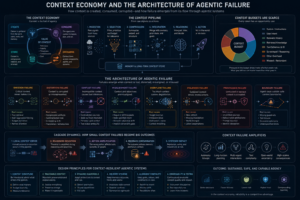
Within this highly hostile, saturated environment, the traditional metrics of digital production—raw volume, speed of publication, and algorithmic visibility—have lost all of their economic utility. The Digital Grapevine research and development practice proposes an alternative survival and operational framework centered entirely on the mastery of the “Context Economy”.3
The fundamental, unyielding thesis of the Context Economy is that raw intelligence and basic content generation are no longer scarce commodities; they are utilities. Therefore, competitive advantage, operational security, and economic value are derived exclusively from the architectural framing that makes artificial intelligence coherent, actionable, restricted, and governable in real-world applications.3 Coherence—which strictly implies logical consistency, persistent memory, and outcome-focused system design—is the ultimate scarcity in a digital environment flooded with disjointed, hallucinatory, and transient synthetic output.3 The underlying philosophy is starkly absolute: the organizations that survive and dominate the AI transition will be those that possess the deepest, most systemic understanding of context.5
The Digital Grapevine operationalizes the Context Economy through a series of highly specific, advanced engineering and design methodologies:
- Agentic Workflow Design: Recognizing that single-prompt interactions are inherently brittle and prone to hallucination, the practice focuses intensely on designing multi-step, AI-assisted processes. In these environments, distinct algorithmic tools, highly specialized AI personas, and various models act in concert, creating autonomous pipelines that dramatically improve execution quality while heavily reducing operational friction.3
- Practical AI Integration and Concept Prototyping: Moving artificial intelligence beyond a “vague idea” or a simple chat interface, the practice emphasizes the rapid, fast-turn prototyping of AI-native products. This involves utilizing advanced agentic coding frameworks to rapidly test working proof-of-concepts, ensuring that AI implementation explicitly and measurably supports actual business operations rather than functioning as speculative, unusable technology.3
- Narrative and Interactive Systems: To actively counter the disjointed, chaotic nature of the Slop Economy, the framework demands the creation of highly continuity-aware experiences. These simulation-based and story-driven systems utilize adaptive digital environments where AI guides user engagement through logical, persistent narrative structures, mimicking the continuity of physical reality.3
- Synthetic Presence & Digital Identity Integration: As biological human presence becomes fundamentally unscalable in an automated world, robust digital identity functions literally as the modern digital grapevine, dictating commercial viability, trust, and visibility.2 The practice deeply explores AI-mediated communication systems, including advanced voice synthesis and avatar generation, allowing organizations to scale brand leadership seamlessly without sacrificing authenticity, historical memory, or tonal coherence.3
- AI-Assisted Development Guidance & Harness Engineering: This is perhaps the most technical and critical pillar, specifically addressing the chaos of automated software creation. Harness engineering applies strict, military-grade discipline to AI-supported coding. By utilizing highly structured pseudocode protocols, standard digital repositories are transformed into robust, governed “operating systems” specifically designed to direct and restrict agentic work.3
Works cited
- Structural Autopsy of the Dead Internet – The Digital Grapevine, accessed May 15, 2026, https://thedigitalgrapevine.com/Articles/Dead_Internet.html
- The Architecture of a Paradigm Shift [Robert Lavigne, The Digital Grapevine], accessed May 15, 2026, https://thedigitalgrapevine.com/the-architecture-of-a-paradigm-shift-robert-lavigne-the-digital-grapevine/
- The Digital Grapevine – https://TheDigitalGrapevine.com, accessed May 15, 2026, https://braagle.ca/
- The Architecture of the Context Economy [Robert Lavigne, The, accessed May 15, 2026, https://thedigitalgrapevine.com/the-architecture-of-the-context-economy-robert-lavigne-the-digital-grapevine/
- Flux in Action: A 26-Step Image Generation Showcase (2024) | by Robert Lavigne | Medium, accessed May 15, 2026, https://medium.com/@RLavigne42/flux-in-action-a-26-step-image-generation-showcase-2024-cd149707f3da
- The Digital Grapevine – https://TheDigitalGrapevine.com, accessed May 15, 2026, https://thedigitalgrapevine.com/
- RLavigne42/Learn-with-Lavigne: A Repository of “Learn … – GitHub, accessed May 15, 2026, https://github.com/RLavigne42/Learn-with-Lavigne
- accessed December 31, 1969, https://braagle.ca/Articles/dead_internet_concept_bitstream_single_source.html
- accessed December 31, 1969, https://braagle.ca/Articles/dead_internet_concept_braagle_single_source.html
- accessed December 31, 1969, https://thedigitalgrapevine.com/Articles/dead_internet_concept_braagle_single_source.html
- accessed December 31, 1969, https://braagle.ca/Articles/dead_internet_concept_digital_grapevine_single_source.html
- accessed December 31, 1969, https://braagle.ca/Articles/dead_internet_digital_grapevine.html
- accessed December 31, 1969, https://thedigitalgrapevine.com/Articles/dead_open_web_braagle_yellow_presentation.html
- accessed December 31, 1969, https://thedigitalgrapevine.com/Articles/dead_open_web_kinsu_dark_presentation.html
- accessed December 31, 1969, https://thedigitalgrapevine.com/Articles/dead_open_web_learn_with_lavigne.html
- accessed December 31, 1969, https://thedigitalgrapevine.com/Articles/dead_open_web_sydnay.html
- Full text of “The Cabinet dictionary of the English language” – Internet Archive, accessed May 15, 2026, https://archive.org/stream/cabinetdictiona00langgoog/cabinetdictiona00langgoog_djvu.txt
- Full text of “Notes and queries” – Internet Archive, accessed May 15, 2026, http://www.archive.org/stream/notesandqueries57haylgoog/notesandqueries57haylgoog_djvu.txt
- A Japanese collection(PPN780551354 – PHYS_0432 – fulltext-endless) – Digitalisierte Sammlungen der Staatsbibliothek zu Berlin, accessed May 15, 2026, https://digital.staatsbibliothek-berlin.de/werkansicht?PPN=PPN780551354&PHYSID=PHYS_0432&view=fulltext-endless
- Kaccayana’s Pali Grammar, accessed May 15, 2026, https://static.sirimangalo.org/pdf/alwiskaccayana.pdf
- accessed December 31, 1969, https://braagle.ca/Articles/final_hybrid_test.htm
- accessed December 31, 1969, https://thedigitalgrapevine.com/Articles/initial_hybrid_test.htm
- accessed December 31, 1969, https://thedigitalgrapevine.com/Articles/final_hybrid_test.htm
- accessed December 31, 1969, https://thedigitalgrapevine.com/Articles/Fresh_Hyrbid_Render.htm